Every day, commercial trucks cross the Illinois River on the Murray Baker Bridge, roll through the I-74 interchanges at Camp Street and Washington Street, and travel US Route 24 and US Route 150 through the heart of Peoria. When one of those trucks is involved in a crash, the damage can be devastating. These are not ordinary accidents.
A serious truck crash can leave you with major injuries, mounting medical bills, and no clear sense of what to do next. The company behind that truck almost certainly has an insurance team and attorneys already working to limit what they pay. You deserve someone in your corner. You may be able to recover compensation for medical expenses, lost wages, pain and suffering, and more, and we want to help you understand your options.
Onward Accident & Injury Law represents people injured in truck accidents in Peoria, East Peoria, and throughout Peoria and Tazewell Counties. Our closest office is our Bloomington headquarters at 308 E Washington St, Suite C, roughly 40 miles east on I-74. We are available by phone 24/7; consultations are free, and we work on contingency, meaning you pay nothing unless we recover for you. If you have been hurt, contact our law firm today.
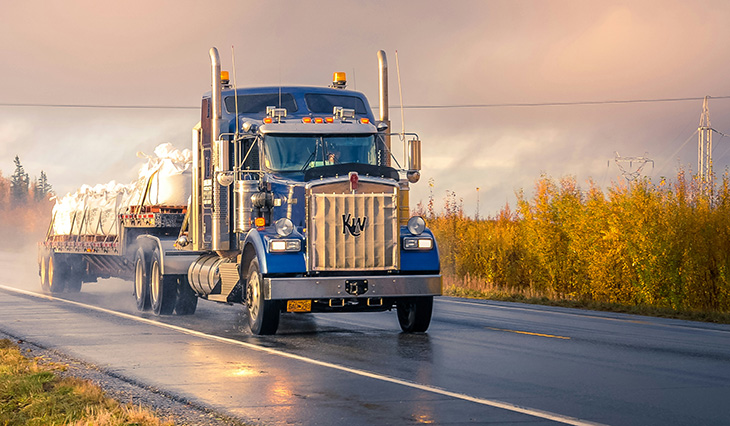
How Truck Accidents in Peoria Differ from Other Crashes
A collision with a semi-truck, tanker, or delivery rig is different from a typical two-car accident, and the legal process is different too.
The Dangerous Size and Weight of Large Trucks
A fully loaded commercial truck can weigh 80,000 pounds. A passenger car weighs around 4,000. That size difference means truck crashes cause far more severe injuries: spinal damage, traumatic brain injuries, broken bones, internal injuries, and in the worst cases, wrongful death.
In addition to the physical injuries to drivers and passengers, the commuter vehicles in these collisions are often totaled.
Multiple Parties May Be Responsible in Trucking Crashes
In a commuter car accident, liability usually involves the two drivers. In a truck accident, liability can involve the truck driver, the trucking company, a cargo loader, a truck owner separate from the carrier, a maintenance contractor, or a parts manufacturer.
Figuring out who is responsible and why requires reviewing federal safety records, logbooks, black box data, maintenance logs, and more. You shouldn’t try to sort this out on your own while you are recovering.
Federal Rules Apply to Trucking Accident Claims
The Federal Motor Carrier Safety Administration (FMCSA) regulates commercial trucking. FMCSA rules cover driver hours of service, weight limits, cargo securement, drug and alcohol testing, and vehicle inspection requirements.
When a carrier or driver violates those rules and someone is hurt, that violation matters. Our truck accident lawyers serving Peoria know how to find and use that evidence.
Where Truck Accidents Happen in Peoria
Peoria’s geography creates specific conditions that matter for truck crash risk. The city sits between the Illinois River bottoms and the bluffs, so several streets climb steep grades out of downtown. Add to that major river crossings, overlapping state routes, and industrial traffic from Caterpillar Inc., and you have a road network that demands careful attention.
The I-74 Corridor and River Crossings
I-74 is the main artery into and out of Peoria, and it crosses the Illinois River on the Murray Baker Bridge with exits at Camp Street, Washington Street, and Main Street (Exits 92 through 96). These interchanges handle a heavy mix of commuter vehicles and commercial trucks. Merging traffic, abrupt lane changes, and high speeds make these ramps and interchanges among the more dangerous stretches in the area.
The I-474 Shade-Lohmann Bridge to the southwest adds a second river-crossing route where heavy freight moves regularly.
Camp Street, Main Street, and the Overlapping Routes
Several signed state routes share the same pavement through the Camp Street and Main Street area. US Route 24, US Route 150, Illinois Route 8, Illinois Route 29, and Illinois Route 116 all run together in overlapping stretches here. That means multiple routes worth of truck traffic compressing into the same city streets.
Trucks turning, accelerating out of interchanges, and navigating these corridors alongside regular traffic increase the risk of crashes. This is especially true near the Cedar Street Bridge approach on IL 116 and the McClugage Bridge approach on US 150.
The Levee District and West Washington Street
The Levee District is East Peoria’s main retail and restaurant area. The area is bounded by West Washington Street, Clock Tower Drive, West Camp Street, and Spinder Drive. It draws steady foot traffic, especially during the Farmer’s Market, Music in the Park, and the Levee District Cruise-In.
Large parking lots, pedestrians cutting across lanes, and delivery trucks maneuvering in and out of the Levee District create conditions where a moment’s inattention leads to a serious collision.
Caterpillar and Industrial Traffic
Caterpillar Inc. has major facilities in Peoria. Shift changes, heavy equipment deliveries, and supplier trucks are a regular part of the traffic picture around the plant.
Large trucks moving in and out of industrial areas, turning onto local streets and intersecting with commuter traffic create elevated collision risk, particularly during morning and afternoon shift changes.
Rural Roads in Peoria County and Tazewell County
Outside of the city, there are vast stretches of farmland throughout Peoria and Tazewell counties. Two-lane country roads carry slow-moving farm equipment during planting and harvest seasons. Tall corn cuts off sightlines at field driveways and rural intersections. In addition, speeds on open rural highways are often higher.
When a commercial truck is also on one of these rural roads, a miscalculation can be catastrophic. Emergency response times are longer in these areas, which means injuries that might be manageable near a city can become life-threatening.
What to Do After a Truck Accident in Peoria
Prioritize Your Health
Even if you feel fine after a truck accident, go get checked out by a doctor. Some injuries may not be apparent immediately. Getting medical attention right away helps establish a connection between the collision and the trauma you experienced.
You can visit local medical facilities such as OSF Saint Francis Medical Center (the region’s Level I trauma center) or Carle Health Methodist Hospital. There is also Carle Health Pekin Hospital to the south.
Document What You Can
If it is safe to do so, take photos at the scene of the crash. Get the truck driver’s information, the carrier name, the DOT number on the truck, and the names of any witnesses. Do not sign anything from an insurance company, and do not give a recorded statement before speaking with an attorney.
Call Us Before You Talk to the Insurance Company
The trucking company’s insurer will likely contact you quickly. Their goal is to settle fast and for as little as possible. Onward Accident & Injury Law can step in, handle those communications, and make sure your rights are protected from the start.
Illinois Law and Your Truck Accident Claim in Peoria and Tazewell Counties
Statute of Limitations for Trucking Accident Claims
In Illinois, most personal injury claims must be filed within two years of the date of the accident. If you wait too long, you lose the right to pursue compensation, no matter how strong your case. If a government entity is involved, that window may be even shorter (sometimes one year) with special notice requirements. Do not wait.
Partial Fault in Large Truck Collisions
Illinois follows a modified comparative negligence system. If you are found partially at fault for the crash, your compensation is reduced by your percentage of fault. As long as you are not more than 50% at fault, you can still recover.
Insurance companies sometimes try to shift blame onto the injured person to reduce their settlement payout. Our truck accident attorneys serving Peoria know how to push back on insurers.
Compensation That May Be Available After a Truck Crash
Depending on the facts of your case, you may be able to pursue compensation for:
- Medical Expenses: Emergency care, surgery, hospitalization, rehabilitation, ongoing treatment, and future medical needs.
- Lost Wages: Income you missed while recovering, and reduced earning capacity if your injuries affect your ability to work long-term.
- Pain and Suffering: The physical pain and emotional toll the crash has placed on your life.
- Property Damage: The cost of replacing or repairing your vehicle and other belongings damaged in the wreck.
- Wrongful Death: If you lost a family member in a truck crash, compensation may be available for funeral costs, lost financial support, and loss of companionship.
Talk to a Truck Accident Lawyer in Peoria for Free
Truck crash cases move fast. The carrier’s team is already working the case. Evidence disappears. Witnesses become harder to reach. The sooner you have someone in your corner, the better positioned you are.
At Onward Accident & Injury Law, we are available 24/7. We handle the hard stuff, and we do not get paid unless you do. We are a firm that gives a damn about the people we represent, and we will work hard to get you a fair outcome. Call us anytime or contact our law firm today to schedule your free consultation. We know the area and are ready to help.
Get your free consultation
It only takes a few minutes.
"*" indicates required fields
Locations
Our Results
-
$5.25 Million
Trucking Accident
Iroquois County
-
$3.5 Million
Motor Vehicle Accident
Logan County
-
$2.75 Million
Motor Vehicle Accident
Christian County

Frequently Asked Questions About Truck Accidents in Peoria, IL
Truck cases involve federal regulations, multiple potentially liable parties, and far more documentation, including driver logs, inspection records, and black box data. They also tend to involve larger insurance policies and more aggressive defense from the carrier’s legal team. That is why having an attorney who handles these cases matters.
Generally two years from the date of the accident. If a government entity is involved, it may be shorter. The sooner you act, the better your chances of preserving evidence.
The driver following the rules does not necessarily mean the carrier is off the hook. Improper maintenance, defective equipment, or negligent loading by another party may still support a claim. We look at the full picture.
You may still be able to recover. Under Illinois modified comparative fault rules, you can pursue compensation as long as you are not more than 50% at fault. Your recovery would be reduced by your share of fault.
No. We work on contingency. You pay nothing unless and until we recover compensation for you. Your consultation is free.