Share this article


Stay Safe This Harvest Season: Tips for Sharing the Road with Farm Equipment (2026)
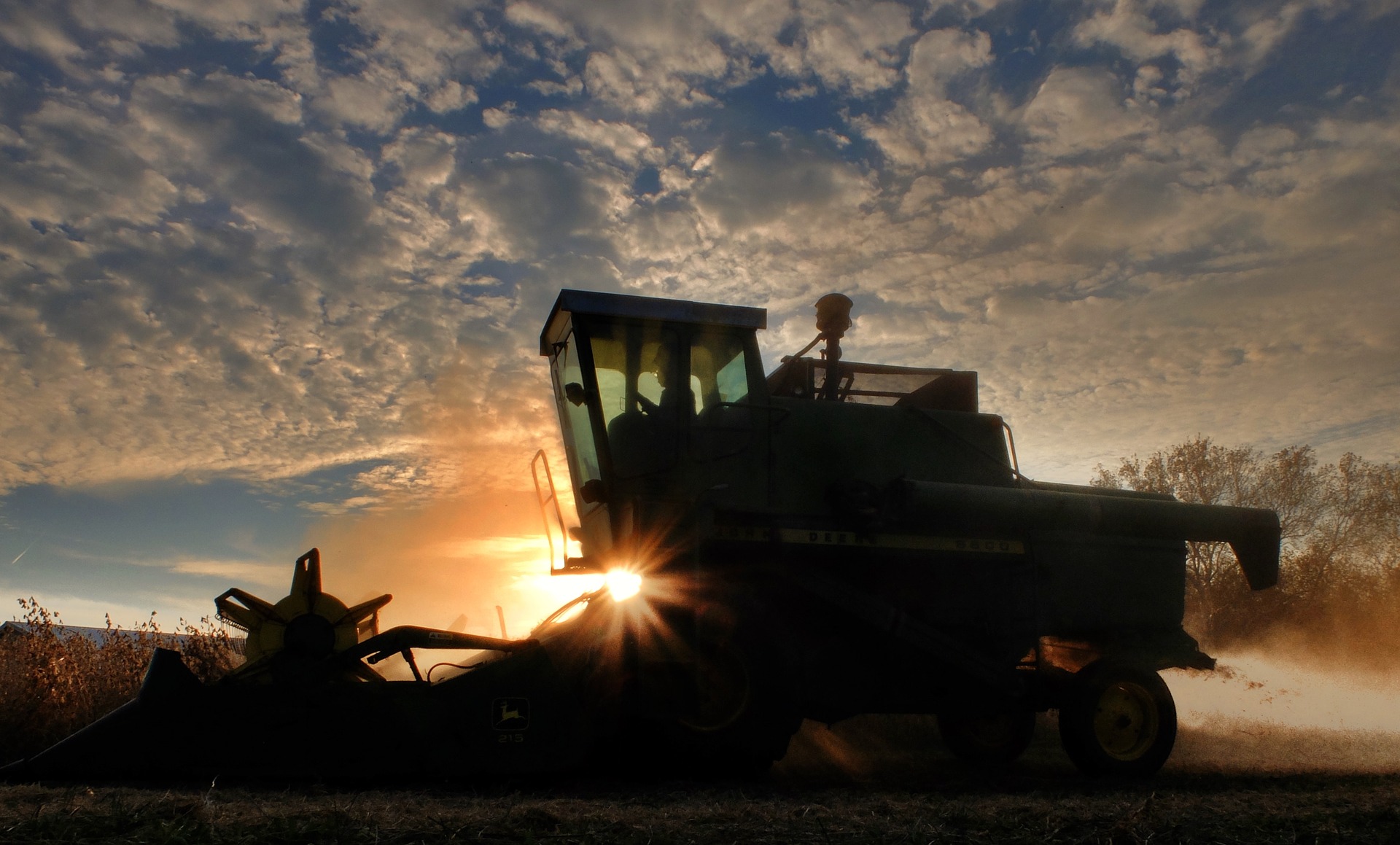
Harvest is here. In McLean County and across Central Illinois, it started in mid-September this year. For the next six to eight weeks, you’ll see combines, tractors, and grain trucks on the same roads you take to work and school.
We sat down with Anna Ziegler, manager of the McLean County Farm Bureau, to talk about what harvest looks like from the cab. Watch it first if you can. This guide picks up where the video leaves off, with local numbers, a quick guide to what you’re seeing on the road, and what to do if something goes wrong.
Harvest Season by the Numbers
- 275 crashes in Illinois involved tractors or other farm equipment in 2024, based on IDOT data.
- 42% of farm equipment crashes in a nine-state Midwest study (including Illinois) happened during harvest season.
- Rear-end crashes are the most common type. A car comes up fast behind slow equipment and can’t stop in time.
- About 8 in 10 farm equipment crashes happen in daylight, and most happen in clear weather.
That last one surprises people. We tend to think of dark, foggy nights. But most of these crashes happen on sunny afternoons, when drivers feel relaxed and aren’t expecting to come up on a tractor.
Why You Have Less Time Than You Think
In the video, Anna explains how far you travel in five seconds at 55 mph. Here’s the other side of that math: how fast the gap closes.
If you’re going 55 and a tractor ahead is going 25, you close the distance by about 44 feet every second. A tractor a full football field ahead? You’ll be on its back bumper in about 7 seconds.
If it’s a combine moving at 15 mph, that drops to about 5 seconds.
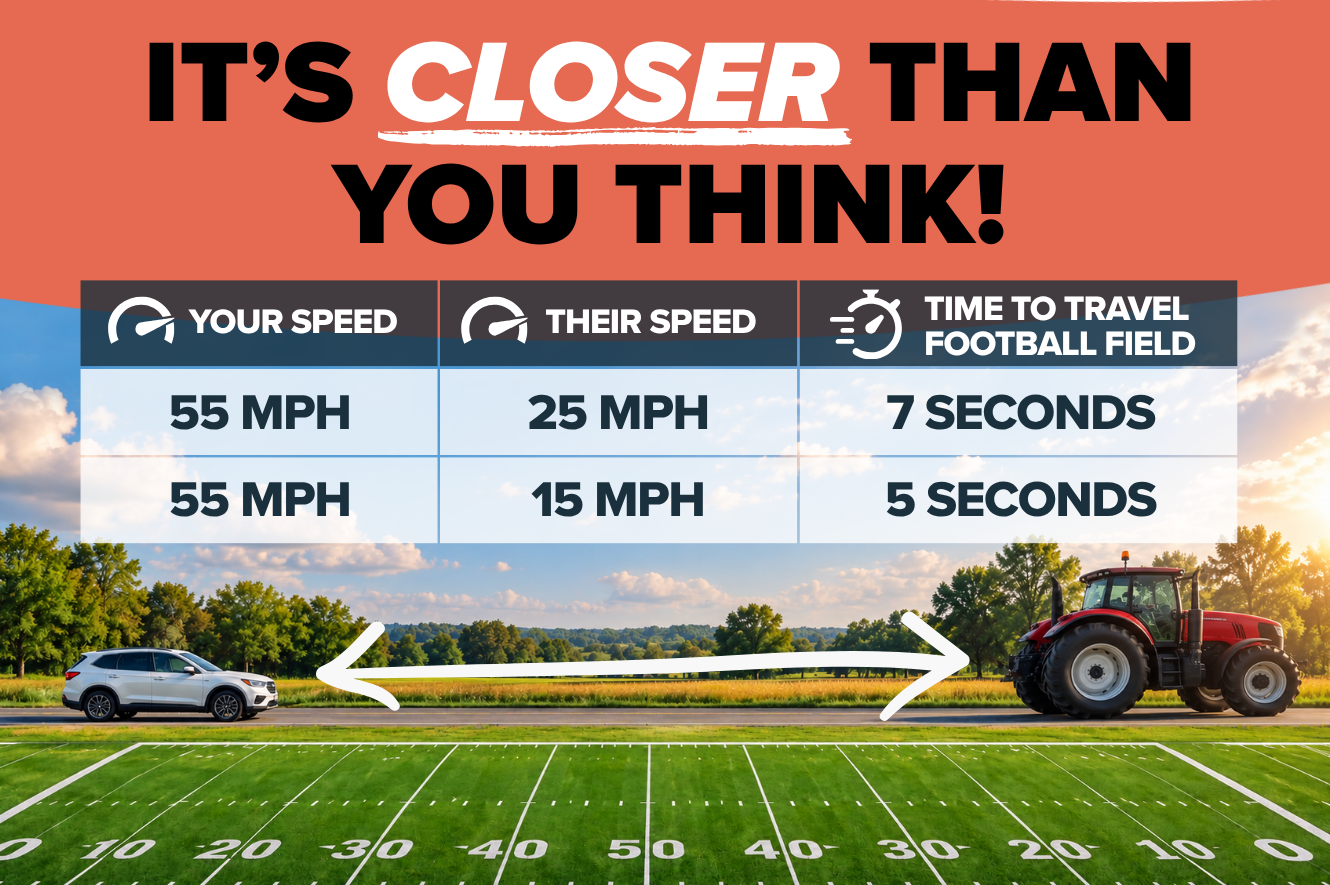
A quick look at your phone takes most of that. That’s why the moment you spot that orange triangle, your foot should come off the gas.
Passing Farm Equipment in Illinois
Passing is where good intentions go wrong. Before you pull out, ask yourself:
- Is it legal here? In Illinois, it’s illegal to pass in a no-passing zone or at an intersection. That includes farm equipment.
- Can I see far enough ahead? Hills and curves hide oncoming cars.
- Is there a field drive, lane, or driveway coming up? The tractor might be turning into it.
- Is the driver pulling over to let me by? If so, pass slowly. The equipment may still be wider than the space it left you.
- Will my tires leave the pavement? On narrow rural roads, they often do. Gravel and grass change your grip. Slow way down.
If the answer to any of these isn’t a clear yes, wait. A few extra minutes behind a tractor won’t change your day. A crash will.
The Three Crashes to Watch For
1. Rear-end crashes. The most common kind. Prevent it by scanning far ahead, slowing early, and keeping a big gap. Following farther back also helps you see around wide equipment.
2. Left-turn crashes. A driver tries to pass just as the tractor turns left into a field. Prevent it by never passing a tractor that’s slowing, drifting right, or near a field entrance.
3. Passing crashes. A driver pulls out without enough room and meets oncoming traffic, or clips the equipment. Prevent it by passing only when it’s legal and you can see well ahead.
For Parents: A 5-Minute Talk With Your Teen Driver
Many new drivers have never come up on a combine at night. A quick talk before harvest can make a real difference. Here’s what to cover:
- “If you see an orange triangle, slow down first right away. Don’t wait until you get closer.”
- “Never pass farm equipment in a no-passing zone, even if they are going really slow.”
- “If a tractor moves right, it might be turning left. Don’t assume they are getting over for you.”
- “Being late is always OK. I’d rather you be late than get hurt in an accident.”
As adults, we’ve been driving around farm equipment for years most likely. Our teens and young adults haven’t. They may need extra reminders on how to stay safe.
Plan Ahead This Harvest
- Leave 10 minutes early. As Anna says in the video, time pressure leads to risky choices.
- Clean your windshield inside and out. Low fall sun plus a dirty windshield can blind you, especially at dusk and dawn.
- Turn on your headlights early. Days are getting shorter, and the time change is coming.
- Know your backup route. If you often get stuck behind equipment, a paved road with a passing lane may be faster.
If You’re in a Crash With Farm Equipment
We hope you never need this. But if it happens, these steps can protect your health and your claim.
- Get somewhere safe and call 911. Even if it seems minor, get a police report.
- Get checked by a doctor. Some injuries don’t show up right away. Always seek medical attention to be safe.
- Take photos. Get the equipment lights, reflectors, and SMV sign (or lack of one), the road, and where each vehicle ended up. Take photos of any damage to your vehicle and any visible injuries you have
- Get names and contact info from the driver and any witnesses.
- Be careful what you tell insurance companies. You don’t have to give a recorded statement to the other party’s insurance.
Farm crashes can be more complicated than a typical car crash. More than one insurance policy may be involved, like a farm policy, a commercial trucking policy, and your own auto policy. It’s easy to feel lost. You don’t have to figure it out alone.
Frequently Asked Questions
Can I pass a tractor in a no-passing zone in Illinois?
No. It’s illegal to pass in a no-passing zone or at an intersection, even if the vehicle ahead is moving slowly.
How fast does farm equipment go?
Anything with an SMV sign is built to go 25 mph or less. Many combines move even slower on the road.
When is harvest season in Central Illinois?
Usually September through November, depending on the weather. In 2026, it started in mid-September.
What should I do if I’m hurt in a crash with farm equipment?
Get medical care first. Then call a personal injury lawyer before you sign anything or give a recorded statement to an insurance company.
A Shared Road
Anna said it best at the end of our talk: “Farmers are people. They have families.” They want to get home safe, and so do you. Slow down, stay patient, and let’s all get where we’re going this fall.
Heading into colder months? Check out our winter driving safety tips.
Hurt in a Rural Road Crash? We’re Here to Help.
At Onward Injury Law, we help good people through tough times. If you or someone you love was hurt in a crash with farm equipment, we’ll handle the insurance companies and the paper work. You focus on healing.
Call us day or night for a free consultation.
Share this article